
Legal support roles, such as paralegals, legal analysts, and legal researchers, are essential across law firms, companies, and government agencies. By handling research, compliance, and client prep, they support attorneys and contribute to a strong legal support jobs outlook for 2025 and beyond.
Paralegals and legal assistants alone generate nearly 40,000 openings each year, mostly from retirements and career changes. For students and career changers, the challenge is balancing coursework with the need to gain real-world legal experience.
Many address this by seeking mentorships, internships, and certifications. In some cases, others chose to hire an essay writer for academic support to free up time for building practical skills that matter in the workplace.
This guide looks ahead to 2025 and beyond, covering how these roles differ, what they pay, how AI is reshaping their future, and which education and career strategies offer the best return.
|
Key Takeaways
|
How Do Paralegal, Analyst, and Researcher Roles Actually Differ in 2025?
People often get confused by legal terminology. Even the term “legal support” gets used as a catch-all, much like how the difference between attorney and lawyer is frequently blurred. However, the day-to-day work of paralegals, analysts, and researchers appears quite different.
Understanding these differences is critical since the responsibilities, pay scales, and career outlooks don’t overlap as much as people assume.
|
Role |
Main Focus |
Typical Tasks |
Work Setting |
|
Paralegal |
Litigation and client suppor |
|
Law firms, courts, corporate legal departments |
|
Legal Analyst |
Risk assessment and compliance |
|
Corporations, consulting firms, and financial institutions |
|
Legal Researcher |
In-depth research and policy evaluation |
|
Government agencies, academia, and think tanks |
Paralegals are the most client-facing of the three. They draft documents, organize discovery, and support attorneys in trial preparation. Their role is defined by direct involvement in casework and ongoing communication with clients.
Legal analysts focus on compliance and risk assessment. They evaluate contracts, monitor regulatory changes, and prepare reports for business units or executives. While they interact less with clients, their influence is broader inside organizations, especially in regulated industries like finance and healthcare.
Legal researchers specialize in deep analysis. They comb through case law, legislative history, and policy sources to build the foundation for arguments or reports, making legal research careers attractive to those interested in policy and academia.
Researcher roles are common in academia, government, and think tanks, where accuracy and depth of analysis are more important than client interaction.
Education Requirements
Educational paths differ by role, shaping both entry speed and long-term advancement. While all require solid research and writing skills, the level of formal study isn’t the same.
- Paralegal: Entry is usually through a certificate or associate degree, though many employers now prefer a bachelor’s. ABA-approved programs carry weight, and certifications such as NALA’s Certified Paralegal provide added credibility and require continuing education.
- Legal Analyst: Most positions require a bachelor’s degree in fields like law, political science, or business. Advancement often depends on industry credentials, which are especially valuable in finance and healthcare.
- Legal Researcher: A bachelor’s degree is the usual starting point, but advanced study is often expected for academic or policy careers. Coursework in legal research methodology, case law analysis, and statutory interpretation is common.
With the education pathways established, the next question is how those choices translate into salaries and long-term job growth.
What Are the Salary Ranges and Growth Projections for Each Path?
Compensation varies significantly across legal support roles, reflecting differences in specialization and demand.
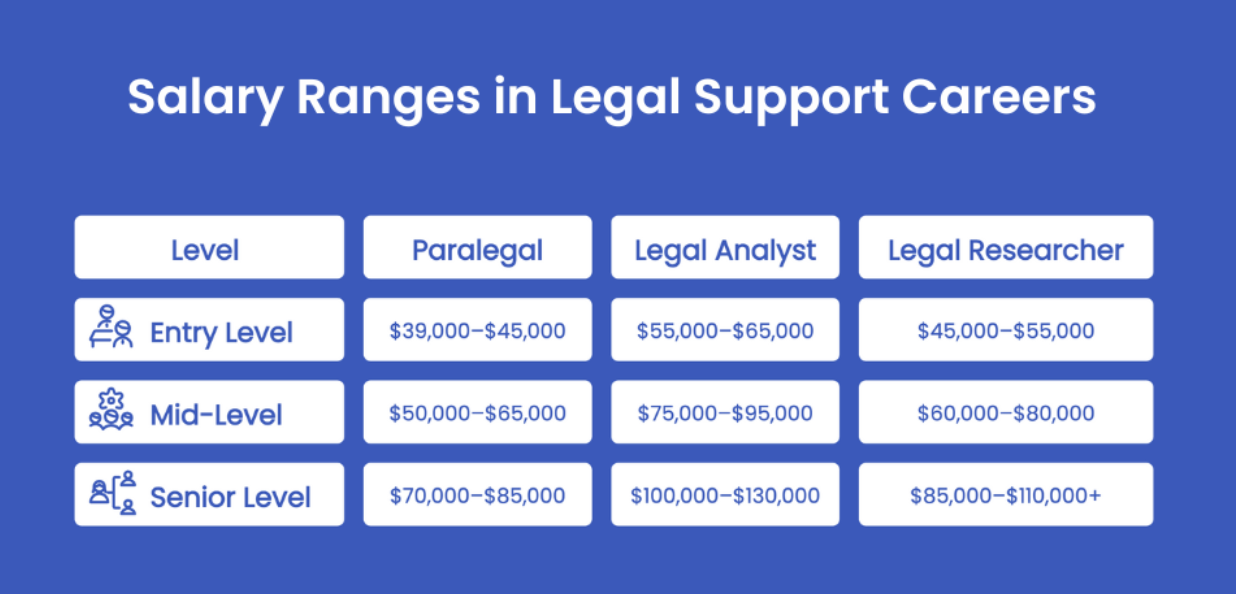
Paralegal pay is steady, with a national median of $61,010 in 2024. Job growth is expected to be flat through 2034. However, about 39,300 openings per year will continue to arise from retirements and career changes.
Legal analysts earn more, particularly in compliance-heavy sectors. Corporate postings in 2025 show salaries from $55,000 to $120,000, and demand is rising about 8% due to expanding regulatory requirements, as highlighted in the legal analyst salary guide published this year.
Legal researchers see modest growth but higher potential in specialized environments. Government roles average $55,000 to $85,000, while private sector or senior research positions can exceed $150,000. Opportunities are strongest in policy hubs like Washington, D.C.
How Is AI Transforming Each Type of Legal Support Role?
Artificial intelligence is no longer experimental in the legal industry. It is now part of daily practice.
Adoption is skyrocketing. In 2025, 46% of firms with 100 or more attorneys reported using AI-based tools, up from just 16% two years earlier. Among mid-sized firms, about 39% have adopted legal-specific generative AI.
For legal support staff, this shift doesn’t mean replacement so much as redefinition. Paralegals, analysts, and researchers each interact with AI differently, and their responsibilities are being reshaped accordingly.
The following sections break down how technology is transforming the work of each role.
What AI Applications Are Specific to Paralegal Work?
AI is transforming how paralegals manage document-intensive tasks. Tools such as Early Case Assessment (ECA) are helping reduce the number of documents that need full review. In some cases, such tools shrink that pool by about 74% for teams using advanced filtering tools.
Employers are increasingly expecting paralegals to work with AI tools, checking output for errors, understanding how to utilise document management systems, and integrating digital tools into case workflows.
The 2025 Robert Half Guide reports that many legal departments are now seeking skills tied to AI or automation.
How Are Legal Analysts Leveraging AI for Enhanced Performance?
Legal analyst roles are being reshaped by real shifts in what companies expect. Over half of law firm and in-house legal department managers now specify AI or automation skills in their job postings, reflecting changing demands in legal skillsets.
Around 38% of corporate legal departments already use AI tools daily. Another 50% are actively exploring implementation. This includes tools for contract review, regulatory change tracking, document analysis, and compliance workflows.
In addition, 44% of legal department leaders say they use generative AI in 2025, up markedly from the previous year. Because of this, analysts with experience using AI-enabled legal tech, predictive tools, or contract automation are gaining an edge.
What AI Means for Legal Research Professionals
AI is accelerating legal research workflows, especially when large volumes of case law or statute must be sifted quickly. 65% of lawyers believe generative AI tools will assist them with research, higher than for drafting or document analysis.
Thomson Reuters reports that 74% of legal professionals are already using AI tools to support research tasks, such as searching legal databases or summarizing case law.
AI doesn’t replace human researchers. People working in this role now focus more on evaluating AI output, showing how legal support roles artificial intelligence complement human judgment rather than replace it.
The technology helps design research strategies and apply judgment about what arguments or precedents matter most. Lawyers and in-house legal teams are factoring these changes into hiring.
Researchers who understand AI tools, can assess results critically, and integrate those tools into their workflow are becoming more valuable.
Where Are the Best Markets and Opportunities for Legal Support Roles?
Geography plays a major role in shaping opportunities for legal support staff. While remote work is expanding, certain cities remain key career hubs.
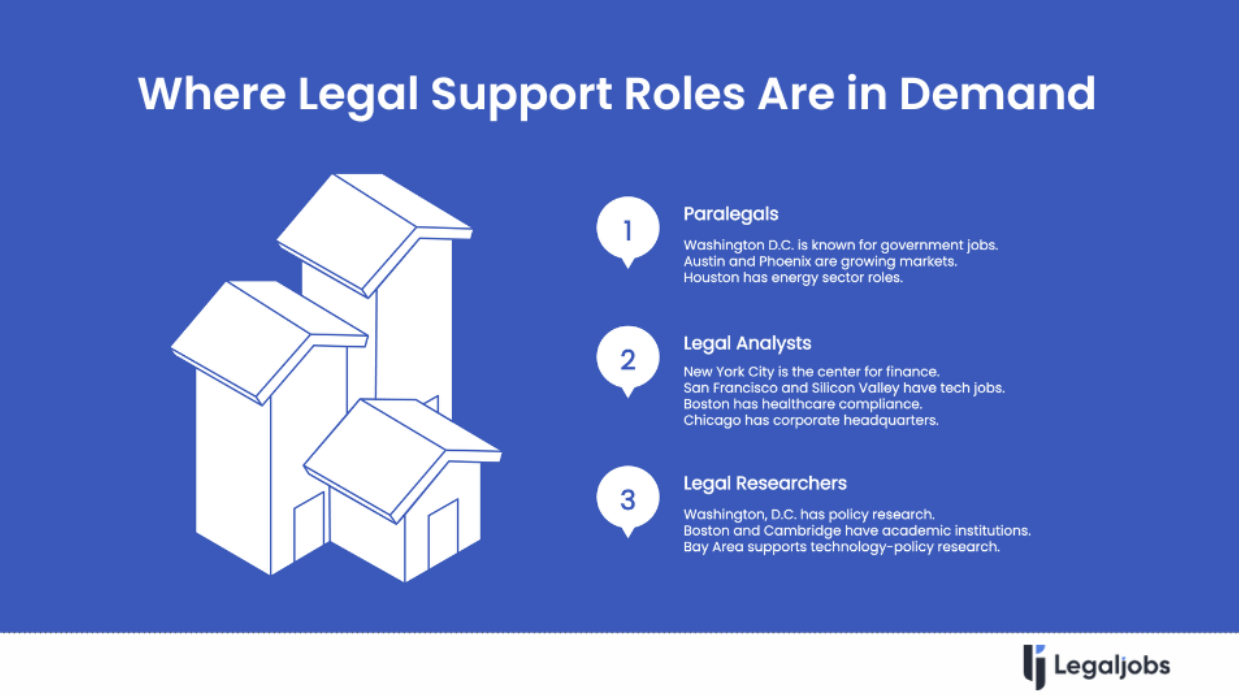
- Paralegals
- Washington, D.C., stands out for government-related work, with a dense concentration of federal agencies and courts.
- Austin and Phoenix are fast-growing markets where expanding tech and healthcare industries fuel demand.
- Houston offers specialized roles tied to the energy sector.
- Legal Analysts
- New York City remains the center for finance and regulatory work.
- San Francisco and Silicon Valley drive opportunities in technology and data privacy.
- Boston is a hub for healthcare and biotech compliance.
- Chicago continues to offer openings in corporate headquarters and consulting.
- Legal Researchers
- Washington, D.C., is a leading market for policy research and think tanks.
- Boston and Cambridge are home to strong academic research institutions.
- The Bay Area supports technology policy research through Stanford, Berkeley, and surrounding institutions.
Remote availability differs: researchers benefit from the broadest flexibility, analysts fall in the middle, and paralegals remain the most office-based because of client and courtroom work. Still, industry surveys show that hybrid arrangements are increasingly common across all three roles.
What Education and Career Development Strategies Work Best for Each Role?
Education plays a distinct role in shaping the careers of paralegals, legal analysts, and legal researchers. Some paths emphasize quick entry through certificates or associate programs, while others require advanced degrees or specialized credentials.
Employers consistently highlight three priorities across all roles:
- Formal education
- Recognized certifications
- Ongoing training in legal technology
The following subsections break down how aspiring professionals in each role can plan their development for both immediate entry and long-term growth.
What’s the Optimal Education Path for Aspiring Paralegals?
Paralegals have multiple entry routes, each with different costs and timelines:
- Certificate programs typically take 6–12 months and cost between $5,000–$15,000. These evolving paralegal education requirements 2025 reflect rising employer expectations for formal training.
- Associate degrees usually take about two years, with tuition ranging $15,000–$25,000. This option offers a broader foundation and is popular with new graduates.
- A bachelor’s degree plus a paralegal certificate can take four years or more and exceed $50,000 in tuition, but it often leads to higher-paying corporate or government positions.
- Bootcamps and online programs run 3–6 months and cost $3,000–$8,000. They allow quick entry but offer less specialization.
Specialization adds value. Training in e-discovery, compliance, or litigation technology can improve hiring prospects, with some of the highest-paying paralegal specializations emerging in corporate law and healthcare.
Professional credentials like the NALA Certified Paralegal (CP), NALS Professional Paralegal (PP), or other certifications can also strengthen your credentials as a paralegal.
How Should Legal Analysts Build Their Career Foundation?
Legal analysts typically need a bachelor’s degree in business, economics, political science, or law. Employers often prefer candidates with a strong grounding in regulation and compliance, along with data analysis skills.
Career advancement often depends on specialized certifications:
- Certified Compliance & Ethics Professional (CCEP): Recognized in corporate and financial sectors for compliance roles.
- Risk Management credentials (FRM, PRM): Common in finance and consulting.
- Privacy certifications (CIPP, CIPM): Increasingly important in technology and healthcare industries.
Robert Half’s 2025 Legal Salary Guide highlights compliance and risk specialists as among the fastest-growing non-attorney roles, with AI and data literacy now listed as preferred skills in many postings.
Short-term courses in data analytics for law or legal project management also help analysts stand out in competitive corporate markets.
What Development Path Maximizes Legal Research Career Potential?
Legal researchers usually begin with a bachelor’s degree in law, political science, or a related field.
For those aiming at policy, academic, or government careers, advanced degrees such as a JD, LLM, or master’s in public policy are often expected. This opens up a range of career paths open to law degree holders.
Specialization raises earning potential:
- Policy analysis: Master’s in public policy or JD, leading to roles in government or think tanks.
- International law: JD or LLM, valued by NGOs and global organizations.
- Regulatory research: JD/MBA combinations prepare researchers for corporate compliance and advisory roles.
Strong research methodology, statistical analysis, and academic writing skills are essential, along with proficiency in legal databases. Publishing in journals or policy briefs, attending conferences, and gaining government or fellowship experience help build credibility.
Researchers with advanced degrees and publication records are most competitive in senior academic or policy positions.
How Important Is Technology Training Across All Legal Support Roles?
Technical skills are now considered essential for paralegals, analysts, and researchers alike. Employers consistently list legal technology proficiency as a differentiator in hiring and promotion.
Key tools include:
- Legal research platforms: Westlaw, LexisNexis, Bloomberg Law.
- Case and document management systems: Clio, Relativity, cloud-based collaboration tools.
- Data analysis and visualization software: increasingly relevant for legal analysts.
- Citation and research management tools: used heavily by legal researchers.
The American Bar Association’s 2024 Legal Technology Survey reported that over 70% of legal professionals now rely on cloud-based tools daily, while demand for AI-related skills is expanding rapidly.
Professionals who can integrate AI, manage digital workflows, and ensure compliance with data privacy rules are commanding salary premiums of 15–30% in many markets.
What Does Career Success Look Like for Each Role in 2025 and Beyond?
Success in legal support careers is no longer measured only by salary. Employers and professionals now look at advancement opportunities, specialization, flexibility, and recognition within the field.
The benchmarks differ for paralegals, analysts, and researchers. However, all three roles share an emphasis on continuous learning, technology adoption, and cross-disciplinary collaboration.
The following subsections outline how success is defined in practice for each career path.
How Do You Measure Paralegal Career Success in the Modern Legal Environment?
Paralegal success is measured by more than years of service. Employers increasingly look for signs of professional growth and added value to legal teams:
- Financial growth: Consistent salary progression, with premiums for specialization in litigation support, compliance, or e-discovery.
- Professional recognition: Achieving and maintaining certifications, leading continuing education sessions, or metoring junior staff.
- Work flexibility: Hybrid or remote arrangements are now common in larger firms and corporate legal departments, reflecting industry shifts toward more sustainable workloads.
- Leadership opportunities: Senior paralegals often move into supervisory roles, managing teams of support staff or coordinating trial preparation across departments.
These indicators highlight that career success for paralegals comes from combining legal expertise with adaptability, leadership, and ongoing professional development.
What Defines Success for Legal Analysts in Corporate and Consulting Environments?
Legal analysts succeed when they demonstrate measurable impact on business operations and compliance. Employers value analysts who:
- Reduce risk and costs: Quantifying savings from improved compliance systems or streamlined contract reviews.
- Strengthen collaboration: Working effectively with finance, compliance, and executive teams to align legal insights with strategic goals.
- Advance quickly: Many analysts move into senior or managerial roles within five to seven years, especially in risk or compliance leadership.
- Stay adaptable: Analysts who embrace AI-driven analytics and legal technology are increasingly prioritized in hiring and promotion decisions.
Compliance and risk analysts remain among the fastest-growing corporate legal support roles, with strong upward mobility for those combining legal knowledge and data skills.
How Do Legal Researchers Build Lasting Impact and Recognition?
Career success for legal researchers is closely tied to influence and credibility. Publishing in respected journals and policy reports builds authority, while invitations to contribute to government inquiries or legislative hearings signal recognition at a higher level.
In international contexts, multilingual ability and cross-border research experience often determine access to senior roles.
Advancement also depends on the ability to translate findings into practical guidance. Researchers who can connect legal analysis to economic, social, or regulatory outcomes are more likely to secure leadership positions in think tanks, academic institutions, or NGOs.
What Are the Common Long-Term Career Evolution Paths?
Legal support roles often serve as stepping stones to broader opportunities. Common transitions include:
- Paralegals → Legal Operations Managers: combining case management skills with oversight of technology and workflows.
- Legal Analysts → Compliance Directors: moving from data interpretation to strategic oversight of risk and regulation, a pathway often looked into by those asking how to become a legal research analyst.
- Legal Researchers → Policy Advisors: shifting from academic or statutory analysis to direct input on legislative or regulatory decisions.
Some professionals leverage their experience to prepare for law school, where practical knowledge offers an advantage. Others branch into legal technology startups, consulting, or government service, where cross-disciplinary skills are highly valued.
These paths show that legal support work is not static. It can evolve into leadership roles across law, business, and policy—or even into less traditional legal careers for those who want to move beyond the courtroom.
