
For years, claims for injuries caused by bicycles were buried in larger traffic accident data. They were there, but they didn’t often affect how personal injury law firms set up their teams or used their resources. Motor vehicle accidents were the most common and got the most attention.
That equilibrium has changed. According to data from the U.S. Census Bureau, the number of people who ride to work in big cities has been consistently rising since the late 2010s. The number of people who use e-bikes, on the other hand, has skyrocketed since 2019. At the same time, national injury datasets show that bike accidents are getting worse, not just more common.
As these factors come together, personal injury law companies are seeing a steady rise in cycling-related claims. This has led many of them to hire more specialized bicycle accident lawyers to handle the volume and complexity of modern micromobility litigation. What started as a revolution in transportation is now affecting how personal injury law is performed.
Micromobility Adoption Trends Driving Legal Exposure
Litigation volume goes up with exposure. The more people ride bicycles and e-bikes in traffic with other types of vehicles, the more likely it is that they will crash. Adoption data reveals that this growth is not just ephemeral; it is structural.
Growth in Bicycle and E-Bike Usage
The American Community Survey says that more and more people are riding their bikes to work in big U.S. cities. Cities that put money into protected bike lanes and urban cycling networks saw the biggest improvements.
As ridership has expanded in dense urban corridors, bicycle accident lawyers are seeing a noticeable increase in claims tied to commuter routes, protected lanes, and mixed-traffic streets rather than isolated recreational incidents.
E-bikes have accelerated this growth. According to Circana, U.S. e-bike sales more than tripled from 2019 to 2022 and stayed high through 2024. PeopleForBikes says that e-bikes currently make up a larger-than-normal percentage of all cycling miles traveled.
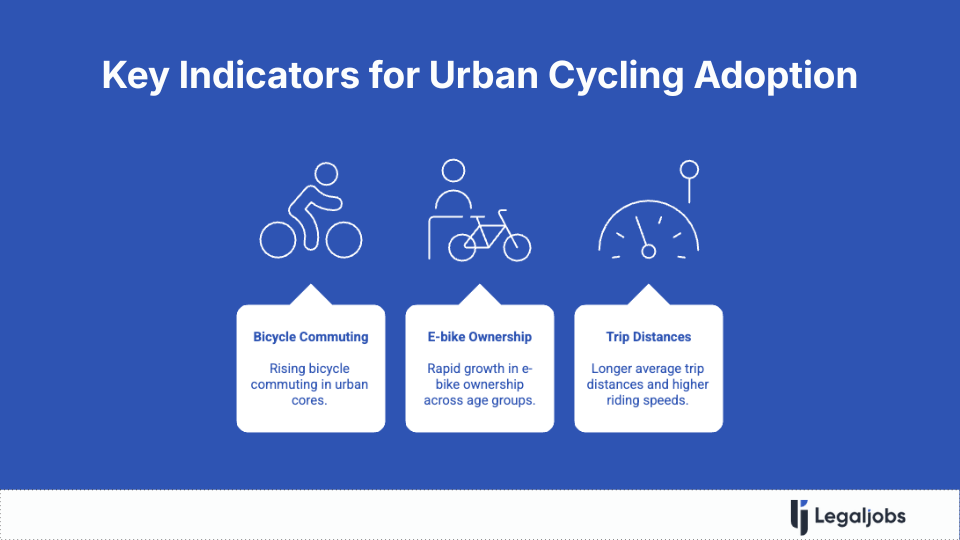
Some important signs of adoption are:
Growth of Shared Micromobility Platforms
Shared micromobility projects have grown a lot. The National Association of City Transportation Officials says that there are more than 133 million shared micromobility journeys per year in the US and Canada.
These devices let people with different levels of experience ride in busy traffic areas. Infrastructure growth has often lagged behind deployment, which raises the risk of exposure.
Injury and Fatality Data Behind Rising Claims
Adoption alone doesn’t lead to lawsuits. But the frequency and severity of injuries do. Data on public health and transportation safety currently indicate clear positive trends in both areas.
Trends in the Emergency Department and Hospitalization
The U.S. Consumer Product Safety Commission says that injuries related to micromobility went up by over 21% in 2022 compared to 2021. Between 2017 and 2022, almost 360,800 people went to the emergency room because of bicycles, e-bikes, and other comparable equipment.
Injuries from e-bikes are growing the fastest. A study by JAMA Network Open discovered that the number of e-bike injuries in the U.S. went up from 751 in 2017 to 23,493 in 2022. This means that almost half of all e-bike injuries happened in 2022.
Injury Severity Comparison
| Metric | Traditional Bicycles | E-Bikes |
| Average operating speed | Lower | Higher |
| Hospital admission rate | Moderate | Higher |
| Head injury incidence | Lower | Significantly higher |
| Injury severity trend | Stable | Rapidly increasing |
The CDC WISQARS data and peer-reviewed medical research also suggest that e-bike riders are more likely to get head injuries, broken bones, and internal injuries. These kinds of injuries are more likely to lead to claims that turn into lawsuits.
Patterns of Fatality in Cities
According to data from the NHTSA Fatality Analysis Reporting System, the number of cyclists who died in the U.S. has been continuously rising over the past ten years. Most deaths happen in cities where there are a lot of cars.
State DOT reports always say that arterial highways and crossroads are dangerous places. Speed differences and disputes when turning are still the key causes.
Translation of Injury Trends Into Litigation Volume
There isn’t one dataset that courts use just for bicycle lawsuits. But insurance data, appellate rulings, and municipal risk surveys all show that there are more legal cases related to bike accidents.
How Often Claims Happen in High-Density Areas
The Insurance Research Council says that claims for bodily injury are going up for people who are more likely to get hurt on the road. Even when the number of traffic incidents goes down, areas with more people who ride bikes have more claims per person connected to biking.
California and New York, for example, have seen an increase in civil cases featuring cyclists as plaintiffs. These cases are usually grouped with other personal injury cases, even as legal practice areas continue to become more specialized.
Increasing Case Complexity
More and more, cycling and micromobility cases have more than one defendant. These might be drivers, cities, property owners, or manufacturers.
As liability theories overlap and rules change, the need for evidence grows. This rewards cross-disciplinary litigation skills but makes cases take longer and cost more to fight in court.
Liability Frameworks for Bicycle and Micromobility Incidents
Cycling and micromobility incidents sometimes involve more than one set of laws, which is not the case with regular car accidents. Negligence, poor design of infrastructure, or flaws in a product can all lead to liability.
Motorist Negligence and Right-of-Way Conflicts
Studies by the National Highway Traffic Safety Administration (NHTSA) show that not yielding, hazardous passing, and not judging speed correctly are some of the main causes of cycling accidents. Police reports sometimes mention problems with visibility at intersections.
State vehicle codes require drivers to do things that are special to cyclists. Different places have different ways of interpreting and enforcing the law.
Infrastructure and Product Liability Considerations
Claims for road design and maintenance have gone up as bike infrastructure has grown. Expert evidence now often cites the safety advice from the Federal Highway Administration.
There is also a greater risk of product responsibility. The CPSC has recalled a number of e-bike batteries, braking systems, and frame integrity issues.
Some common sources of liability are:

Trends in Compensation for Bicycle Accident Claims in the U.S.
Settlement data helps explain why businesses are interested in this area of law. Results can be very different, but the numbers show that there is a good chance of getting paid.
Industry studies show that most bicycle accident settlements in the U.S. are between $10,000 and $100,000. Cases with mild injuries tend to be on the lower end of that spectrum.
More comprehensive information indicates that the median payouts are around $45,000. However, the mean settlements might be over $200,000 because serious injury and wrongful death cases pull the mean up.
Bicycle Accident Compensation Ranges (U.S.)
| Injury Severity | Typical Settlement Range |
| Minor injuries | $5,000 – $25,000 |
| Moderate injuries | $25,000 – $100,000 |
| Severe or catastrophic injuries | $100,000 – $1,000,000+ |
E-bikes cause more damage since they go faster, weigh more, and can cause head injuries. These things raise the expense of medical care, the risk of long-term impairment, and the value of claims.
What the Data Says About Areas of Personal Injury Law
The combination of more people adopting, more serious injuries, and more money available for compensation is changing how personal injury law firms work. It’s no longer easy to include cycling claims in ordinary auto lawsuits.
Practice Segmentation and Specialization
More and more, American Bar Association publications are treating bicycle and micromobility lawsuits as separate topics. Regulatory variety and technological vehicle disparities reward targeted expertise and reflect how personal injury firms are adapting their practices.
This is similar to what has happened in the past with medical malpractice and product liability.
Consequences for hiring and practice growth
Reports from legal recruiting firms reveal that there is a growing need for lawyers who know how to handle new types of injuries. In cities, specialization is becoming more and more important for business.
Regulatory and Policy Trends Shaping Future Litigation
The next phase of litigation growth will be shaped by rules. At the state level, legislation around helmets, age limits, and how to classify e-bikes is still changing.
Federal and state money for infrastructure is speeding up the building of bike lanes. Every change to a policy changes how much liability there is and how many claims there will be in the future.
Final Thoughts
The rise of bicycle and micromobility lawsuits is a sign of long-term structural change, not just a short-term spike. Adoption has gone up gradually, injuries have been worse, and the amount of money people get for their injuries has gone up.
Transportation agencies, hospitals, insurance, and courts all have data that points in the same direction. Lawsuits involving cycling and micromobility are becoming a long-lasting and specialized part of personal injury law.
FAQs
Why are lawsuits about bicycles and micromobility on the rise?
The rise in lawsuits is similar to the rise in adoption, the rise in injury severity, and the rise in interactions with motor vehicles. As micromobility becomes a part of city transportation, claims about liability and infrastructure are going up.
What makes bicycle accident cases different from car accident cases?
Roadway design, unclear right-of-way rules, and changing vehicle classifications are common issues in these circumstances. Liability might also fall on cities or manufacturers, not just drivers.
What part do e-bikes play in the trends in lawsuits?
E-bikes go faster and weigh more, and data shows that these factors are linked to more serious injuries. Unclear rules make liability issues even worse.
Are cities now more involved in lawsuits about cycling?
Yes. As towns build more bike lanes, claims are starting to look more closely at how lanes are designed, kept up, and the rules that govern them.
What does this entail for law firms that handle personal injury cases?
The data shows that cycling and micromobility claims will continue to be a rising field of law. Companies that put money into regulatory and technical knowledge are better able to handle these accusations.
