
Corporate law traditionally concentrated on statutes, regulatory compliance, and contractual obligations. Finance addressed markets, capital structures, and investment strategies. In 2025, these disciplines increasingly converge, reshaping the skills required for effective legal practice.
To meet these evolving demands, emerging lawyers seek opportunities to build competencies beyond formal study. Many manage workloads with expert finance assignment help from DoMyEssay. This approach strengthens applied capabilities in both corporate and financial law.
Rising compliance complexity was reported by 85% of corporate legal and compliance professionals, prompting technology investment with major financial implications. These developments make financial knowledge a central component of legal competitiveness.
This article explores why finance skills now determine competitiveness in corporate law. It covers career advantages, salary impacts, the influence of technology, and the expanding education pathways that are shaping the future of the profession.
|
Key Takeaways:
|
The State of Corporate Law in 2025
Corporate law in 2025 is shaped by globalization, complex regulations, and a clear shift toward finance-led strategy. Legal teams are expected to deliver more than sound legal advice and must connect legal risk to financial performance.
In this environment, financial literacy is no longer optional for corporate lawyers and has become a core skill that drives value for clients and employers.
Key Corporate Law Practice Areas Today
Corporate law practice areas are evolving, with finance now central to daily work. Lawyers who combine legal and financial skills outperform peers in the most in-demand fields.
Here are the leading areas:
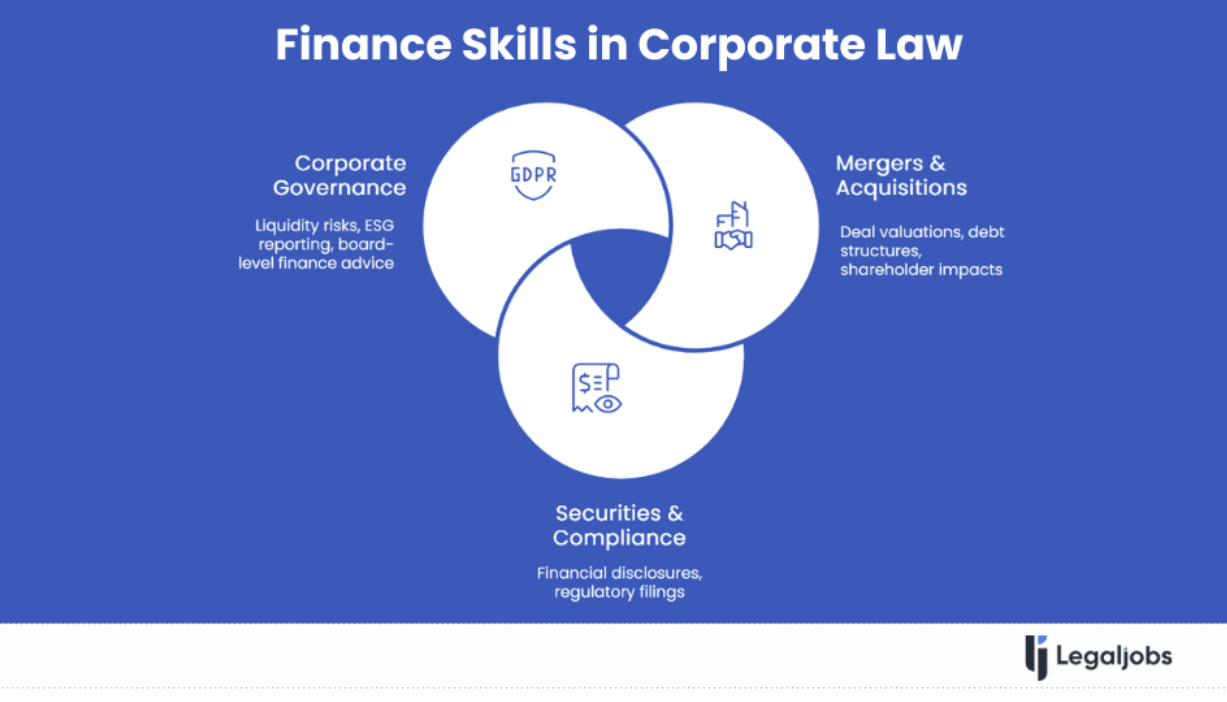
- Mergers and Acquisitions (M&A): Highly competitive and high-paying. Requires interpreting valuations, debt structures, and shareholder impacts.
- Securities and Compliance: Growing due to regulatory complexity. Demands fluency in financial disclosures and reporting obligations.
- Corporate Governance: Boards expect advice framed in financial terms, from liquidity risks to sustainability reporting.
Market Forces Driving Change
Corporate law is shifting because of global economic integration, regulatory reform, and shifting client expectations. Employment of lawyers is projected to grow 4% from 2024 to 2034, with finance-focused specialists best positioned to capture this demand.
This environment requires lawyers to connect legal strategy with financial risk analysis rather than offering isolated legal opinions. The most significant market forces influencing corporate law in 2025 include:
- Globalization: Cross-border deals require knowledge of currency risks, investment restrictions, and foreign regulations.
- ESG and Sustainability: Legal compliance is tied to financial disclosures. Lawyers must ensure accurate reporting for investors and regulators.
- Client Expectations: Businesses seek integrated legal and financial advice, not isolated legal opinions.
These dynamics are not only redefining legal work but also influencing how lawyers are compensated and where demand is strongest.
Salary and Demand Outlook
Corporate lawyers with strong financial expertise are in high demand and consistently earn more than the profession’s median. In 2024, the U.S. Bureau of Labor Statistics reported a median annual wage of $151,160 for lawyers, with top corporate specialists often exceeding this figure.
Within corporate law, certain specializations that require advanced financial skills offer significantly higher earning potential and stronger demand.
|
Area |
Salary Premium Over Median |
Demand Outlook |
|
Mergers & Acquisitions |
Strong demand through 2030, driven by rebounding market activity and AI advancements. |
|
|
Securities Law & Compliance |
Consistent growth and high demand due to ever-increasing global regulatory complexity. |
|
|
Corporate Governance (Finance-led) |
Rising demand as companies face mandatory ESG reporting and litigation risks. |
These figures highlight how finance expertise directly shapes career trajectories in corporate law. Finance literacy accelerates promotion, strengthens client trust, and secures higher pay.
Legal strategy and financial strategy have become inseparable, and lawyers who lack these skills risk stagnating in a rapidly evolving profession.
Why Finance Knowledge Is Now Essential
Alt Tag: Corporate Law’s shift from compliance to finance
Source: corporate-law-shift-from-compliance-to-finance.png
Corporate law runs on numbers as much as statutes. Finance drives decisions in transactions, compliance, and board governance, making financial fluency a core skill.
Lawyers who understand financial principles can bridge the gap between legal obligations and business objectives, becoming indispensable to clients and employers. To see how finance underpins corporate legal work, consider these three core practice areas:
|
Practice Area |
Finance Skills Required |
Value to Clients and Employers |
|
Mergers & Acquisitions |
Valuation analysis, debt structuring, shareholder impact assessment |
Reduces reliance on consultants, improves deal strategy |
|
Securities & Compliance |
Financial reporting fluency, interpreting statements, and disclosure accuracy |
Builds trust, ensures regulatory compliance |
|
Corporate Governance & Risk |
Translating obligations into financial terms, risk quantification |
Supports informed board decisions, prevents liability |
Mergers and Acquisitions
Mergers & acquisitions is one of the most profitable corporate law sectors. In the UK, M&A salaries rose 37% in 2025 (about $128,000), reflecting the premium placed on finance-savvy deal lawyers.
Success in this field requires more than drafting contracts. Lawyers must be able to:
- Assess valuations to determine whether acquisitions create or erode shareholder value.
- Evaluate debt structures to understand risk exposure and repayment obligations.
- Anticipate shareholder impacts that influence approvals, voting outcomes, and potential litigation.
- Review and challenge financial models to cut costs, reduce reliance on consultants, and improve deal strategy.
Those who can read and challenge financial models cut costs, reduce reliance on external consultants, and deliver direct strategic value.
Securities and Compliance
Securities work demands precision in public disclosures and regulatory filings. Advising on IPOs and SEC compliance requires fluency in financial reporting standards.
In the U.S., securities lawyers earn an average of $143,167 per year, with top earners in major financial hubs exceeding $200,000. Demand remains strong as regulatory scrutiny and cross-border listings increase.
Key finance-related tasks include:
- Interpreting financial statements such as balance sheets, income statements, and cash flow reports to confirm accuracy before filing.
- Ensuring regulatory submissions meet SEC and international reporting requirements.
- Translating financial performance into legally compliant investor communications.
- Identifying discrepancies in reported figures that could trigger compliance issues or reputational risk.
Clients place greater trust in lawyers who navigate both the numbers and the regulations, ensuring compliance while strengthening credibility with stakeholders.
Corporate Governance and Risk
At the board level, legal advice must be expressed in financial terms to effectively guide strategic decisions. Many companies are reshaping compliance with this in mind, with 32% investing to leverage new technology and 21% focusing on cost reduction.
This shift shows that legal functions are now judged as much by their financial impact as by their regulatory precision. Boards increasingly seek lawyers who turn legal obligations into financial results and show compliance drives shareholder value.
To meet these expectations, lawyers need the ability to:
- Assess liquidity risks that influence shareholder stability and regulatory obligations
- Integrate ESG metrics into financial disclosures to satisfy investor and regulatory requirements
- Quantify risks through financial analysis to anticipate liabilities and protect directors
- Link compliance requirements to financial results that shape corporate strategy
Lawyers with legal expertise and financial fluency build board confidence and shape strategic direction. This combination opens leadership opportunities far beyond traditional compliance roles.
Technology and Finance Convergence in Corporate Law
Corporate law is entering a phase where technology and finance are deeply connected. AI, fintech, and automation are no longer peripheral tools; they are becoming central to how finance‑related legal work is delivered.
For lawyers, this means understanding not only the legal implications but also the financial logic behind these technologies.
AI and Financial Modeling in Transactions
AI now runs predictive valuations, stress‑tests deal structures, and flags potential risks before they occur. The real advantage comes when lawyers can interpret these outputs and turn them into actionable strategies.
Around 28% of law firms and 23% of corporate legal departments are already using generative AI in their work, with most users engaging weekly or more. Lawyers working with AI in transactions often:
- Use predictive valuations to forecast performance based on market trends and historical data
- Review AI‑driven risk assessments to identify vulnerabilities that could affect deal viability
- Combine AI analytics with legal judgment to improve both compliance and profitability
Fintech and Payment Regulation
Tokenized payment platforms are on track to handle one in four large‑value international transfers by 2030, cutting corporate cross‑border costs by 12.5%. Digital wallets are projected to handle over half of global e‑commerce value, solidifying their role as the dominant payment method.
The surge in mobile payments, tokenized assets, and cross‑border digital transactions is driving a wave of new regulations worldwide. Regulators are rolling out comprehensive frameworks for stablecoins and digital assets, reshaping compliance standards across global markets.
Finance‑savvy lawyers are increasingly called on to guide clients through both legal and economic implications. Key areas of work include:
- Navigating evolving stablecoin and digital asset regulations across jurisdictions
- Tracking global regulatory guidance on tokenized assets and staking
- Strengthening AML and KYC controls to meet FATF standards
- Structuring compliant digital security offerings under updated market rules
- Guiding fintechs through multi‑jurisdiction licensing and capital‑raising
Contract Automation and Smart Agreements
The smart contracts market is valued at over $3.2 billion in 2025 and is projected to grow rapidly in the next decade. These blockchain-based agreements embed financial terms directly into the code and execute automatically when the conditions are met.
While they reduce administrative work, they also raise new legal challenges. Lawyers working with smart contracts need to:
- Validate that automated terms comply with contract law and regulatory standards
- Understand payment triggers, interest calculations, and settlement terms
- Anticipate disputes caused by coding errors or unforeseen market changes
Below is a snapshot of technology areas shaping law and the finance skills needed to address them.
|
Technology Area |
Key Metric (2024–2025) |
Legal Impact |
Finance Skills Needed |
|
AI in Transactions |
36% of law firms and 27% of corporate legal teams use generative AI (Thomson Reuters 2025) |
Faster valuations and risk detection |
Data interpretation, valuation analysis |
|
Fintech Regulation |
Mobile/e‑wallets exceed 50% of digital payments in key markets |
Compliance for crypto and payments |
Regulatory finance, capital structuring |
|
Smart Contracts |
Market valued at $3.2B in 2025 |
Automated execution of terms |
Contract law, financial term validation |
The convergence of technology and finance is redefining corporate law. Lawyers who can navigate both will not just keep pace with change but will lead it.
Career Impact for Corporate Lawyers
Finance knowledge is a decisive advantage in corporate law. It influences who gets hired, how quickly careers progress, and the range of opportunities available to them.
Transactions have become more complex, and clients expect integrated legal and financial insight. Lawyers who can interpret financial statements, model deal outcomes, and assess market risks are better positioned to deliver value.
This capability strengthens day‑to‑day performance and influences long‑term career trajectories, from early promotions to senior leadership roles.
Hiring and Promotion Advantages
Law firms rank finance knowledge among the most valuable skills for junior associates. Candidates who can analyze financial data stand out in competitive recruitment.
In-house teams also expect finance literacy to support collaboration with finance, operations, and executive leadership. This demand from both private practice and corporate employers gives finance‑savvy lawyers broader career options and faster promotion timelines.
|
Career Stage |
Advantages of Finance Skills |
|
Entry‑Level |
Preferred for competitive associate positions in transactional practices |
|
Mid‑Career |
Greater access to complex, high‑profile matters that accelerate promotion |
|
Senior Roles |
Stronger candidacy for leadership positions requiring cross‑functional decision‑making |
Salary Premiums by Specialization
Finance expertise gives corporate lawyers a measurable edge in compensation, especially in roles where financial analysis drives decisions. Those skilled in transaction modeling, valuation, and risk assessment are often fast‑tracked to high‑value matters, accelerating pay growth.
Typical salary ranges for finance‑skilled lawyers include:
|
Specialization |
Typical Total Compensation (Finance‑Skilled) |
Career Impact |
|
Mergers & Acquisitions |
Early involvement in multi‑million‑dollar deals accelerates pay growth |
|
|
Securities & Compliance |
Builds credibility with regulators and boards, ensuring steady workflow and above‑median pay |
|
|
Corporate Governance |
Frames legal obligations in financial terms, leading to strategic advisory roles that shape policy and mitigate risk |
By linking legal expertise with financial fluency, lawyers in these areas command higher salaries. They also build reputations that attract premium clients and open doors to leadership tracks.
Long-Term Leadership Potential
Finance literacy accelerates the path to senior leadership by expanding the scope of a lawyer’s influence beyond legal risk management. Senior roles increasingly require the ability to connect legal advice with strategic financial decision‑making. Lawyers with this dual expertise are positioned to:
- Advise on capital allocation for maximum return and minimal risk
- Shape M&A strategy through deal, valuation, and integration analysis
- Guide market positioning by linking compliance to competitive advantage
- Step into CFO/GC hybrid roles combining operations and legal oversight
These positions typically offer higher compensation, greater influence over corporate direction, and the opportunity to shape both legal and business strategy at the highest level.
Education and Training Pathways for Finance-Savvy Lawyers
Finance fluency has become a core competency for corporate lawyers. Whether in law school or mid‑career, clear pathways exist to gain financial expertise essential for high‑value corporate legal work. The right choice depends on career stage, available time, and professional goals.
Law School Options
Law schools have adapted by expanding finance-related offerings. Students interested in corporate practice can integrate financial training into their legal education.
Common pathways include:
|
Path |
Focus Area |
Career Value |
|
JD/MBA |
Combined legal and business curriculum |
Comprehensive preparation for transactional and in‑house leadership roles |
|
Finance Electives |
Corporate finance, securities regulation, and accounting for lawyers |
Builds analytical skills for deal work and compliance |
|
Clinics & Externships |
Work with corporate clients on real matters |
Hands‑on experience solving |
Certifications and Short-Term Programs
For practicing lawyers, certifications and short courses offer a fast, targeted way to gain finance expertise without leaving practice. These credentials are recognized in both legal and business circles, adding credibility and expanding career options.
|
Program |
Focus Area |
Value for Lawyers |
|
CFA (Chartered Financial Analyst) |
Investment analysis, valuation, portfolio management |
Enhances the ability to assess deals and market risks |
|
CPA (Certified Public Accountant) |
Accounting, auditing, and financial reporting |
Strengthens compliance and governance capabilities |
|
Finance Bootcamps |
Financial modeling, deal structuring |
Quick, applied training for junior or transitioning lawyers |
On-the-Job Learning
Practical experience often accelerates finance learning more than classroom study. Immersing in real transactions and collaborating with finance professionals turns theory into applied skill.
Effective ways to build skills at work include:
- Mentorship from senior lawyers or finance executives
- Rotations in finance, compliance, or corporate strategy teams
- Collaboration with finance departments on deals and budgets
- Self‑study or earning certifications while working
